
Abbreviations used in this document
- FDI – foreign direct investment.
- GDP – gross domestic product.
- GNP – gross national product.
- IMF – International Monetary Fund.
- KRU – Kazakhstan, Russia, and Ukraine.
- PPP – public-private partnership.
- SSR – Soviet Socialist Republic.
- UK – United Kingdom.
1. Introduction – the aim of this essay
By writing this essay, we (the author, Olivian-Claudiu Breda) tried to better understand Kazakhstan and its people, the Kazakhs, by doing some documentation work on the country. We looked at sources of information in English, primarily books, but a few websites and scientific articles, also.
With the data we gathered, the next aim was to see if the reforms and objectives that happened after 1990 were solid enough so that the country could develop quickly but in a sustainable way. But how could the country develop if, first, the people that are part of it don’t have a mental model of success?
We tried to find out if Kazakhstan sets a high-enough target that its mental model of success helps it and will help, in the future, be successful.
We selected below some of the findings from various sources. We tried our best to create a united view of the story.
2. The psychology of aiming high enough
About the question in the title of the current essay, please see this quote – “In numerous studies of how exogenously given goals affect task performance, psychologists indeed document that «difficult» goals induce better outcomes than «easy» goals or the absence of any goal.” (Koch & Nafziger, 2011) So, it would seem essential to set a high bar in order to get good results.
And another quote – “Robert Rosenthal defined the Pygmalion effect as «the phenomenon whereby one person’s expectation for another person’s behavior comes to serve as a self-fulfilling prophecy» (American Psychologist 58.3 [November 2003], p. 839).” (Eden, 2014) There is a saying by Virgil that goes: “For they can conquer who believe they can.” (quoteresearch, 2020) According to these, if you believe in something, this makes it more likely to succeed in achieving that respective thing.
The decisions of Kazakhstan are the decision of its people (both its official leaders and other people). We don’t know how they are thinking; we can’t enter their minds. Kazakhstan used to be the Soviet Republic since 1990, it isn’t so. Two questions may arise: did the people that make Kazakhstan a nation set their goals high enough so that they would motivate them? (1) And, also: do the inner voices that all people have considered as a fact that Kazakhstan has a vast potential and has all the resources it needs to become a prosperous nation? (2)
While we can’t enter the minds of the people of Kazakhstan, we will look at facts and analyze the results of the actions taken by Kazakhstan. We will evaluate the deeds and try to deduce from them, in the end, if Kazakhstan has high enough goals set for themselves and if they believe in those goals so that they can accomplish them.
3. Transition after 1990 in Kazakhstan
Since the declaration of sovereignty, Kazakhstan has encouraged foreign direct investment (FDI) in the Republic. The first law on foreign investment (before national independence by the Kazakh SSR – Soviet Socialist Republics –, 1990) created a framework governing the activity of foreign investors. (Terterov, 2004) From the various sources in this document, we can say that FDI is a significant element in the development of the country. It matters both directly (capital investments, assets) but also indirectly, as a boost in the morale of the population.
In the first years of the 1990s, the economies of the various independent former socialist republics of the Soviet Union saw a downturn. To transform from a centrally planned economy to a market-driven economy – this was a painful process. On the other hand, the country had some advantages – a large country size, large population, and an impressive industrial potential, not to mention the few (in comparison to others) ethnic antagonisms. (Pavlović, 2004) Making a comparison to Romania, we can say that in the first years after the 1990s, a lot of things were new to the way in which the economy worked, so the very first years of freedom, both in Romania and in Kazakhstan, came with sudden changes.
Nursultan Nazarbayev, the 1st president of the new Kazakhstan (December 16, 1991 – March 20, 2019), estimated that the benefits of privatization for the country would start showing in the second part of the 1990s. As time passed, this proved correct. Also, it helped to see the successful exploration for oil and gas – this has raised the Republic’s proven petroleum reserves by half to 8 billion barrels and its natural gas deposits to 1.84 billion cubic meters (in 1995). (Hiro, 2011) Looking in reverse, it is almost incredible to see how accurate the description of Nursultan Nazarbayev was.
4. Overview of the economic situation

Figure 1: GDP growth (annual %), Kazakhstan (GDP growth (annual %) – Kazakhstan)
The GDP growth was impressive in the last part of the 1990s-beginning of the 2000s, but then it slowed down.

Figure 2: Foreign direct investment, net inflows (% of GDP) – Kazakhstan (Foreign direct investment, net inflows (% of GDP) – Kazakhstan)
FDI showed some excellent figures, but there were quite some big variations from one year to the other.

Figures 3 and 4: Population growth, absolute numbers, and growth rate (%) (Kazakhstan population (live))
Except for the initial years after the 1990s, the population of Kazakhstan increased. Of course, there were variations from one year to the other; this is the expected situation.

Figure 5 – Kazakhstan: sectoral distribution of gross FDI inflow (2015-2018) (Anceschi, 2020)
Privatization in Kazakhstan happened in several stages: the privatization of housing using flat coupons (1991–1992), mass privatization by investment privatization coupons (1993–1995), and finally, the privatization of individual projects (1996–1998). (Olcott, 2010)
The most important sector for FDI was the mining industry & development during 2015-2018. While R&D (research & development) services also had some good figures, in 2015-2016, they had a much less importance in the following two years.

Figure 6: Population structure of Kazakhstan by sex and age groups (January 1, 2010) (2010)
At the beginning of 2010, Kazakhstan didn’t have an issue present in some Western countries – an aging population.
5. Economic situation – oil and natural gas

Figure 7: Oil production and consumption in Kazakhstan (Kaiser & Pulsipher, 2007)
While oil consumption stayed relatively the same from 1994-2004, the production grew constantly.

Figure 8: Kazakhstan crude oil: production (Kazakhstan crude oil: Production)
The trend of increased production of crude oil continued in the years 2010-2021.
An important part of Kazakhstan’s economy is dependent on the oil and natural gas reserves located in the Caspian Sea region. (Pavlović, 2004) Depending too much on a small number of resources makes the economy more vulnerable. It’s good to have resources, but don’t base your entire economy on just a few of them.
As the years passed, an important element in having better informal relationships was the gradual Kazakhization of the oil industry. This, intentionally and unintentionally, created a bond between the regime and its clients. (Ostrowski, 2010) It’s a natural phenomenon – having resources attracts other entities.
According to Zoran Pavlović, in 2004, Kazakhstan still had a long way to go to become a developed country. The country is dependent upon energy production. Also, its oil and natural gas production are an important percentage of the country’s annual revenue. This dependence on natural resources makes the economy vulnerable. If one is dependent on a single resource, like oil, this can cause a huge financial shock if prices suddenly drop. (Pavlović, 2004) We showed in a graph that, while the production of oil increased, the internal consumption kept relatively steady.
The same author also says that oil and natural gas production are Kazakhstan’s main economic activity. The situation is encouraged by the growing investment from multinational corporations and foreign governments. Around $10 billion were invested in Kazakhstan’s oil industry between 1992–2001. The oil fields are located generally in the western part of the country and offshore at the Caspian Sea. (Pavlović, 2004) As we can see, the oil industry in Kazakhstan received attention from various parties.
For Wojciech Ostrowski, the country pursued a multi-vectorial foreign policy. It aimed at balancing so-called Eastern and Western interests. The pragmatic approach has won the support of all the important players. The most telling, but not the most important, the relationship has been that with the United States. (Ostrowski, 2010)
Until 2002, independent Kazakhstan was the recipient of $14+ billion in FDI – most of it in the hydrocarbon industry. (Hiro, 2011)
Do note, on the other hand, that while hydrocarbons were the most important element, their GDP share, considering even the related services, was relatively small – 16% in 2004 (IMF, 2005), and all with rapid growth. Their indirect effects were profound, still. (Becker et al.) In Năvodari, the city where we grew up, the local economy is heavily dependent on the Petromidia refinery, from a local high school in the town to a university nearby that both educate people in working at Petromidia. And since lots of people either work for Petromidia or companies related to them, most houses in Năvodari have people who are connected in one way or another to the Rompetrol company.

Table 1: Kazakhstan’s oil contamination by selected regions (Dahl & Kuralbayeva, 2001)
In the table above, we can see the separation of oil contamination in various regions. While oil and things that are related to it (industry, services, people) get generally impact by an increase in production, we shouldn’t forget the ecological impact. We can see in the table with a source by IEB that pollution was an important aspect, and quite a few areas in Kazakhstan were impacted by it.
6. Economic situation – other resources and general climate

Figure 9: Production of selected nonferrous metals in Kazakhstan, 1992-2002 (Peck, 2004)
After an initial decline, after 1992, starting with 1995 and until 2002, there was an almost permanent increase in the production of a selection of nonferrous metals. While less important than oil and natural gas, we should also consider additional resources a country might have.

Table 2: KRU (Kazakhstan, Russia, and Ukraine) region and agriculture indicators, by country, 2008-2012 (Schmitz & Meyers, 2015)
The table shows us a comparison of the area, population, GDP, GDP per capita (how much is produced per person), agricultural impact on the economy, total agricultural area, and share of the agricultural area – compared with total area, the share of the agriculture labor force compared with the total labor force.

Table 3: Distribution of faculty in public and private higher education institutions in Kazakhstan, by highest degree obtained (2017)
We can see in this graph comparison between private/public education and how many people had at least a master’s degree. Also, data about Doctor of Philosophy (PhD), Doctor of Science, and others.
According to Cameron, Kazakhstan is one of the world’s most important exporters of wheat – the country’s most important agricultural commodity. In the years following the Soviet collapse, village households in South Kazakhstan turned to mobile pastoralism. Livestock sector is still a smaller percentage of the country’s economy than grain. (Cameron, 2020) As we can see, the economy is a living organism – it evolves, and it keeps changing and adapting both to the country’s strong points and to the needs of the international market.
Dina Zhansagimova considers that other significant sectors of the economy include commerce, construction, manufacturing, agriculture, and transport. Foreign companies are about 5 percent of the country’s businesses. As a note, most operate by establishing a branch in the country. But representative offices are allowed only to undertake representative functions and protect the interests of the head office. (Zhansagimova) It’s interesting to note that even though the country depends on FDI to build steady growth, there are still problems with laws that make the situation difficult.
Kazakhstan has a territory of approximately 2.7 million square kilometers. It has three time zones with vastly varying topographies and climates. Geopolitics plays a significant role, as the Republic is landlocked and borders the two great powers of Russia and China. There are over one hundred nationalities – the most influential are the Russians. (Cummings, 2005) We can see from the evolution of other countries that having a large population and access to resources can improve the economic status as time goes by. Still, it’s not enough to have resources; it’s important to have the ability to use them properly. A comparison to Romania may prove valid – even for a country with good resources, it proves to be a difficult task to properly use them for the success of the country.
After the 1990s, Kazakhstan is second only to Russia in the abundance of natural resources. When it got its independence, Kazakhstan was almost as rich in human resources as it was in natural ones. The population is relatively small, well-educated, and reasonably well-disciplined. UNDP set the human development index of Kazakhstan in a similar position to Mexico/Poland. (Olcott, 2010) Putting things into context, Mexico benefits from having the United States of America as a neighbor, while Poland is close to the countries of Western Europe. On the other hand, Kazakhstan is close to Russia/China.
It was interesting to see what happened after 2010, so we used a website to see the evolution of HDI in Kazakhstan for a longer period. The trend shows almost constant growth:

Figure 10: Kazakhstan – Human Development Index (Kazakhstan – human development index – HDI 2019)
Kazakhstan tries to reduce the country’s reliance on energy revenues and promote the development of other sectors of the economy. (2011) This, we think, is a very positive sign – to adhere to some important values. Even if targets aren’t met 100%, having a clear target, a North Star to point the direction, can prove a good solution.
Kazakhstan has a rather difficult business climate. This might keep some potential investors away. The legal infrastructure for FDI is far from complete. (Olcott, 2010) There is a saying that goes, “The map is not the territory.” Even if Kazakhstan aims high, they still need to put in practice their values, beliefs, and objectives.
There are some major problems of the Kazakh investment climate: bureaucracy, corruption at a lot of levels, and shortsightedness of civil servants. (Dosmukhamedov, 2002) Again, we can draw a parallel with Romania and other Eastern European countries. We think that even if a country like Romania gave up its communist past, and tried reforms, became a democracy, it still has some connections with its past.
There are some lyrics (translated by us) in a Romanian song by Ada Milea about the ex-ruler of Romania, pre-1990s – Nicolae Ceaușescu (Ceausescu n-a murit):
“He’s in me; he’s in you,
He’s in factories and plants,
Everyone wears it today,
Ceausescu never dies.”
(Ceausescu N-A murit – versuri Ada Milea)
What the song tries to convey, in our opinion, is that even if the exterior changes (ruler of Romania, form of government – democracy, type of economy – capitalism), it’s not that easy to change the mindset. This might be what Titu Maiorescu, a Romanian literary critic and politician, meant when he wrote about the “theory of the forms without a real substance”. (Schifirneț, 2007)
On the other hand, there the theory of the Placebo effects, which claims that “Belief in a treatment may be enough to change the course of a person’s physical illness.”. (Department of Health & Human Services, 2002)
There are two conflicting ideas here – one claims that the form is irrelevant, and it only matters what the real situation is. In this hypothesis, even if Kazakhstan aims to encourage FDI, the real situation may show little improvement, so in this case, it doesn’t matter what the goal is. (1) On the other hand, based on the theory of the Placebo effect and the theory of Robert Rosenthal presented at the beginning of this essay, it might prove that if a state like Kazakhstan claims to be open to FDI, even if their actions don’t match these values 100%, this is a positive thing. It will be a self-fulfilling prophecy, by which if they say one thing, that thing becomes a reality. (2)
Unfortunately, the privatization of Kazakhstan’s most valuable assets is slow and corrupt. (Olcott, 2010) Again, this shows the reality of what happens in Kazakhstan is different from the desired image by their leaders.
The evolution and present organization of Kazakhstan shows reflects the lack of civil society institutions. The Kazakh state has prevented institutions like these from emerging. (Dosmukhamedov, 2002) Although we read some things for this essay about Kazakhstan, most of the readings were on the economic side. How about the people? When looking at Romania’s situation, it matters a lot to look at the mentality – people left Romania for a better future a lot after the 1990s. The civil society in Romania showed some genuine involvement after Colectiv nightclub fire issue ((in 2015, 64 people were killed in a preventable accident), only to reduce this to almost complete silence after August 10, 2018, when there were some conflicts between some people manifesting and the State forces. Kazakhstan is a state, like Romania is, who can be presented via some figures and laws, but needs to be understood by looking at the people. Unfortunately, we’ll do less here in this essay.
7. Interdependence with Russia
Kazakhstan declared its sovereignty in 1990 on October 25. It became an independent country in 1991, on December 16. (Ostrowski, 2010) We can’t but compare this with Romania’s situation, and how it became a free country in a period close to that of Kazakhstan.
In the last years of the Soviet Union, Kazakhstan was the third largest Soviet Republic – net material product (NMP) produced –, and the fourth – industrial output. The World Bank estimated the Republic’s gross national product (GNP) to have been around $25.1 billion in 1991. (Olcott, 2010) Here, what matters is not just the actual figure but to see the evolution in time. We looked at the development of GDP (a similar indicator) in a previous graph.
Kazakhstan, Russia and Ukraine, the main agricultural countries of the former Soviet Union, are becoming more and more important in world agricultural markets after 2000. (Schmitz & Meyers, 2015) Of course, the data analyzed for the current study doesn’t consider the current conflict Russia/Ukraine, as there is not that much data available, and figures are likely to change a lot, since there’s still an active conflict.
Despite Kazakhstan’s enormous mineral wealth, it is hard to overstate the difficulty of the tasks facing the principal state enterprises in the first years of the 1990s. The Soviet emphasis on large enterprises made a very small number of enterprises the whole part of the production chain. (Peck, 2004) Again, when comparing this to Romania’s situation, we can say that the actions taken are similar – prior to 1990, there were State-run companies, some of them big in size, which after privatization, either were lost completely or made more efficient. About Rompetrol’s Petromidia refinery case – we have lived close to it for the most part of our lives, and people close to us worked there (we live in Năvodari, Constanța, Romania). We think that Petromidia’s privatization was a success model, with modernization, and increase in efficiency, and training of personnel. Still, in Năvodari, there were some other factories, and most of them, after becoming private, disappeared completely. Privatization didn’t always bring what we define as “success” (even if, in this case, the definition of the word might be debatable).
Russia relation with Kazakhstan was changed by the demise of the ruble zone in November 1993. The tenge – the new currency, was launched in 1993 on November 15. (Olcott, 2010) Romania kept its currency, but due to high inflation for a long time, went through a redenomination, where it basically divided the old value by a factor of 10,000.
The hyperinflation in the years 1992 – 1993 stemmed from several factors. Forced savings accumulated in the last years of the 1980s as unintended deposits grew because of shortages of goods. Price controls were removed in January 1992. Then, the overhang dissipated into 200% per month inflation. Inflation accelerated again in the second half of 1993 – when the CBR (The Central Bank of Russian Federation) unexpectedly replaced Soviet rubles and set constraints on changing them into Russian rubles. (Becker et al.) It’s easy to say “hyperinflation”, and just add some figures, but one must think of the real tragedies in societies, where people likely saw years of work losing their value, or people losing money and so on. It’s important to always think at the way in which the population is impacted by the decision taken by the State.
In April 1999, Kazakhstan introduced a free-floating exchange rate regime. (Olcott, 2010) This could mark the way of a change in perception
By 2003, Kazakhstan reached its Soviet-era level of GDP and afterward far surpassed that. (Becker et al.) It’s encouraging to see that when the whole society is united in the wish for a better future, positive things happen.
There are also challenges in public–private partnership (PPP) deals. Problems include issues with legislation surrounding partnerships; weak institutional development; non-existent civil participation in the design, approval process, and monitoring of PPPs; underdeveloped financing institutions, channels; the government tends to push for standardized contracts and encourage template solutions while it engaging in non-standardized contracts for other projects; lack of PPP-specific governance structures and established procedures; ambiguous government approach to risk allocation; excessive government regulation of PPPs; finally, a contradictory perception of a policy paradigm, where the latter serves as an instrument for massive PPP deployment. (Mouraviev & Kakabadse, 2017) When analyzing PPP, it’s always a good idea to put this into the context of the corruption. For years, Romania had various issues mixing people in power (from the State) with money and resources from the private sector. The situation is so bad that even at the simple mention of the PPP situation, some people might associate this with a corrupt transaction. We looked at Kazakhstan’s situation, and since corruption is a problem for it, too, we could conclude that PPP might have issues due to this.
8. What does the future hold?
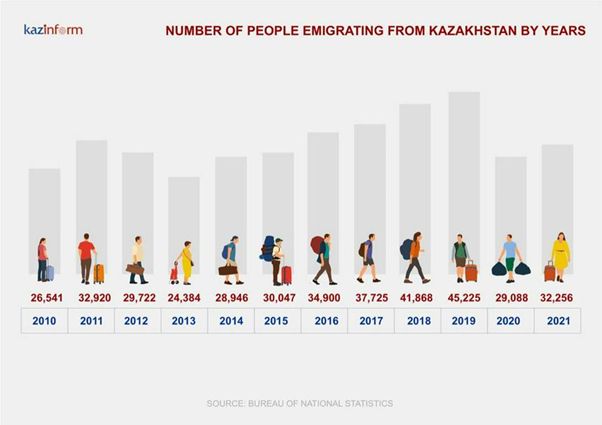
Figure 11: Number of people emigrating from Kazakhstan by years (Satubaldina, 2022)
Kazakhstan’s economic potential is enormous – it combines natural and human resources. At the time of independence, the economy and industrial plants were integrated with those in Russia. The energy grids and supply lines also ran north-south as opposed to east-west. (Olcott, 2010) Unlike Romania, the people of Kazakhstan didn’t emigrate as much after 1990. Comparing the physical resources is one thing but having the human capital to use those resources is also crucial. If the most motivated part of the population decides to leave the country, even if a country is rich in resources, it will likely have difficulties putting those resources to good use.
A source of friction with investors for the future will be unresolved divergences in perceptions of contract fairness, risk sharing, and the relative attractiveness of the oil reserves. Also, there might be issue with ever-evolving model contracts and tax code changes. (Kaiser & Pulsipher, 2007) Once more, we see that there is a difference in the way in which the Government of Kazakhstan aims to do things (with a focus on FDI, with openness to foreign investors) and the way in which things happen.
There is an emotional issue that needs to be resolved among Kazakhs: they must concentrate on the future rather than relive the past. It is obvious even to outsiders that many ethnic Kazakhs and ethnic Russians still have the image of the Soviet Union on their minds. (Pavlović, 2004) We talked in this essay about how Nicolae Ceaușescu, the former ruler of Romania, is still very much embedded in the very essence of the people. Change is never easy, and things from the past tend to linger on.
Kazakhstan will continue to have difficulty attracting FDI, mainly outside the oil and gas sector. They will need to regulate corrupt practices. (Olcott, 2010) This is a rather grim perspective. What we tended to learn in Romania is that progress, though slow and, perhaps, due to this, unsatisfactory, tends to change things for the better. If you live in the country and only focus on recent time, you might have difficulty spotting progress. If you compare that same country from an external perspective and pick a longer timeframe, you might notice more improvement.
Kazakhstan is a peaceful and life-loving country – it has much to offer. Kazakhs should invite outsiders to visit their country. Their country is not just a former nuclear testing range, a space center, or an oil field. It has an exciting and unique culture and destination. (Pavlović, 2004) A Romanian newspaper launched “Why don’t you come over?”, a campaign that gave reasons to travel to Romania. The campaign was a response to a British one: “Don’t come to the U.K.,” suggesting Romanian citizens avoid the U.K. as a place to live and work. (Gandul.info, 2018) Perhaps this would be a good approach – instead of focusing on the negative aspects’ others present when speaking about Kazakhstan; a better solution would be to invite others to come to Kazakhstan and see how things are.
9. Conclusion: is Kazakhstan aiming high enough?
Based on all the resources analyzed, we conclude that Kazakhstan has been evolving quite nicely after independence. As years pass, more and more proof points to Kazakhstan become a modern economy and form of government. There are issues, of course.
There is a tendency to slow down the growth in the past few years. Yet, we need to acknowledge that Kazakhstan of 1992 is much different than Kazakhstan 30 years later.
About the objectives/targets of Kazakhstan – coming back to the question in the essay’s title: are the objectives/targets of Kazakhstan high enough? As we said, we can’t enter the minds of the people in Kazakhstan. We need to estimate if they aim high enough based on actual results.
Our conclusion: we can say that yes, the Kazakhs are aiming high enough, but there’s never enough – you can always wish for something more.
Our suggestion to Kazakhstan and its people, the Kazakhs: “Keep aiming high! Keep wishing for more, and more will happen!”.
We’ll end the essay with a rather funny quote by Norman Vincent Peale: “Shoot for the moon. Even if you miss, you’ll land among the stars.”. (A quote by Norman Vincent Peale)
Bibliography
- A quote by Norman Vincent Peale (no date) Goodreads. Goodreads. Available at: https://www.goodreads.com/quotes/4324-shoot-for-the-moon-even-if-you-miss-you-ll-land (Accessed: October 14, 2022).
- Anceschi, L. (2020) Analysing Kazakhstan’s foreign policy: Regime neo-eurasianism in the Nazarbayev era. Abingdon: Routledge Taylor & Francis Group.
- Becker, C.M. et al. (no date) Social Security Reform in transition economies. Lessons from Kazakhstan. Springer Nature.
- Cameron, S.I. (2020) “Introduction,” in The Hungry Steppe: Famine, violence, and the making of Soviet Kazakhstan. Ithaca: Cornell University Press.
- Ceausescu N-A murit – versuri Ada Milea (no date) Ceausescu n-a murit – versuri Ada Milea. Available at: https://www.versuri.ro/versuri/ada-milea-ceausescu-n-a-murit/ (Accessed: October 14, 2022).
- Competitiveness and private sector development: Kazakhstan 2010: Sector competitiveness strategy (2011). Paris: OECD Publishing.
- Cummings, S.N. (2005) Kazakhstan power and the elite. London: I.B. Tauris.
- Dahl, C. and Kuralbayeva, K. (2001) “Energy and the environment in Kazakhstan,” Energy Policy, 29(6), pp. 429–440. Available at: https://doi.org/10.1016/s0301-4215(00)00137-3.
- Department of Health & Human Services (2002) Placebo effect, Better Health Channel. Department of Health & Human Services. Available at: https://www.betterhealth.vic.gov.au/health/conditionsandtreatments/placebo-effect (Accessed: October 14, 2022).
- Dosmukhamedov, E.K. (2002) Foreign direct investment in Kazakhstan: Politico-Legal Aspects of Post-Communist transition. London: Palgrave Macmillan UK.
- Eden, D. (2014) “Self-fulfilling prophecy and the pygmalion effect in management,” Management [Preprint]. Available at: https://doi.org/10.1093/obo/9780199846740-0014.
- Foreign direct investment, net inflows (% of GDP) – Kazakhstan (no date) Data. Available at: https://data.worldbank.org/indicator/BX.KLT.DINV.WD.GD.ZS?end=2020&locations=KZ&start=1992&view=chart (Accessed: October 13, 2022).
- info (2018) “why don’t you come over?”, a campaign by gandul.info in response to the British one called “Don’t come to england”, Gândul. Available at: https://www.gandul.ro/english/why-dont-you-come-over-a-campaign-by-gandulinfo-in-response-to-the-british-one-called-dont-come-to-england-10536418 (Accessed: October 14, 2022).
- GDP growth (annual %) – Kazakhstan (no date) Data. Available at: https://data.worldbank.org/indicator/NY.GDP.MKTP.KD.ZG?locations=KZ (Accessed: October 13, 2022).
- Higher education in Kazakhstan 2017 (2017). Paris: OECD Publication.
- Hiro, D. (2011) Inside central Asia: A political and cultural history of Uzbekistan, Turkmenistan, Kazakhstan, Kyrgyzstan, Tajikistan, Turkey, and Iran. New York, NY: Gerald Duckworth.
- Kaiser, M.J. and Pulsipher, A.G. (2007) “A review of the oil and gas sector in Kazakhstan,” Energy Policy, 35(2), pp. 1300–1314. Available at: https://doi.org/10.1016/j.enpol.2006.03.020.
- Kazakhstan – human development index – HDI 2019 (no date) com. Follow us. Available at: https://countryeconomy.com/hdi/kazakhstan (Accessed: October 14, 2022).
- Kazakhstan crude oil: Production (no date) Kazakhstan Crude Oil: Production, 1960 – 2022 | CEIC Data. Available at: https://www.ceicdata.com/en/indicator/kazakhstan/crude-oil-production (Accessed: October 13, 2022).
- Kazakhstan population (live) (no date) Worldometer. Available at: https://www.worldometers.info/world-population/kazakhstan-population/ (Accessed: October 13, 2022).
- Koch, A.K. and Nafziger, J. (2011) “Self-regulation through goal setting*,” Scandinavian Journal of Economics, 113(1), pp. 212–227. Available at: https://doi.org/10.1111/j.1467-9442.2010.01641.x.
- Mouraviev, N. and Kakabadse, N. (2017) Public-private partnerships: Policy and governance challenges facing Kazakhstan and Russia. London, United Kingdom: Palgrave Macmillan.
- Olcott, M.B. (2010) Kazakhstan: Unfulfilled promise? Washington, D.C: Carnegie Endowment for International Peace.
- Ostrowski, W. (2010) Politics and oil in Kazakhstan. London: Routledge.
- Pavlović Zoran (2004) Kazakhstan. Broomall, PA: Chelsea House.
- Pavlović Zoran (2004) Kazakhstan. Broomall, PA: Chelsea House.
- Peck, A.E. (2004) Economic development in Kazakhstan the role of large enterprises and Foreign Investment. London: RoutledgeCurzon.
- quoteresearch, A. (2020) Whether you believe you can do a thing or not, you are right, Quote Investigator. Available at: https://quoteinvestigator.com/2015/02/03/you-can/ (Accessed: October 14, 2022).
- Satubaldina, A. (2022) Number of people emigrating from Kazakhstan goes down, according to latest data: August 6 2022, 12:35 – news on Inform.kz, Казинформ. Kazinform. Available at: https://www.inform.kz/en/number-of-people-emigrating-from-kazakhstan-goes-down-according-to-latest-data_a3963750 (Accessed: October 14, 2022).
- Schifirneț, C. (2007) (PDF) Formele Fara fond, un brand Romanesc – Researchgate, formele fara fond, un brand romanesc. Available at: https://www.researchgate.net/publication/258507477_formele_fara_fond_un_brand_romanesc (Accessed: October 14, 2022).
- Schmitz, A. and Meyers, W.H. (2015) Transition to agricultural market economies: The future of kazakhstan, Russia and Ukraine. Wallingford: CABI.
- Terterov, M. (2004) Doing business with Kazakhstan. London: Kogan Page.
- WOMEN AND MEN IN KAZAKHSTAN. Statistical brochure (2010). Astana.
- Zhansagimova, D. (no date) Kazakhstan – culture smart!: The Essential Guide to Customs.
Share on WhatsApp
Ads: